
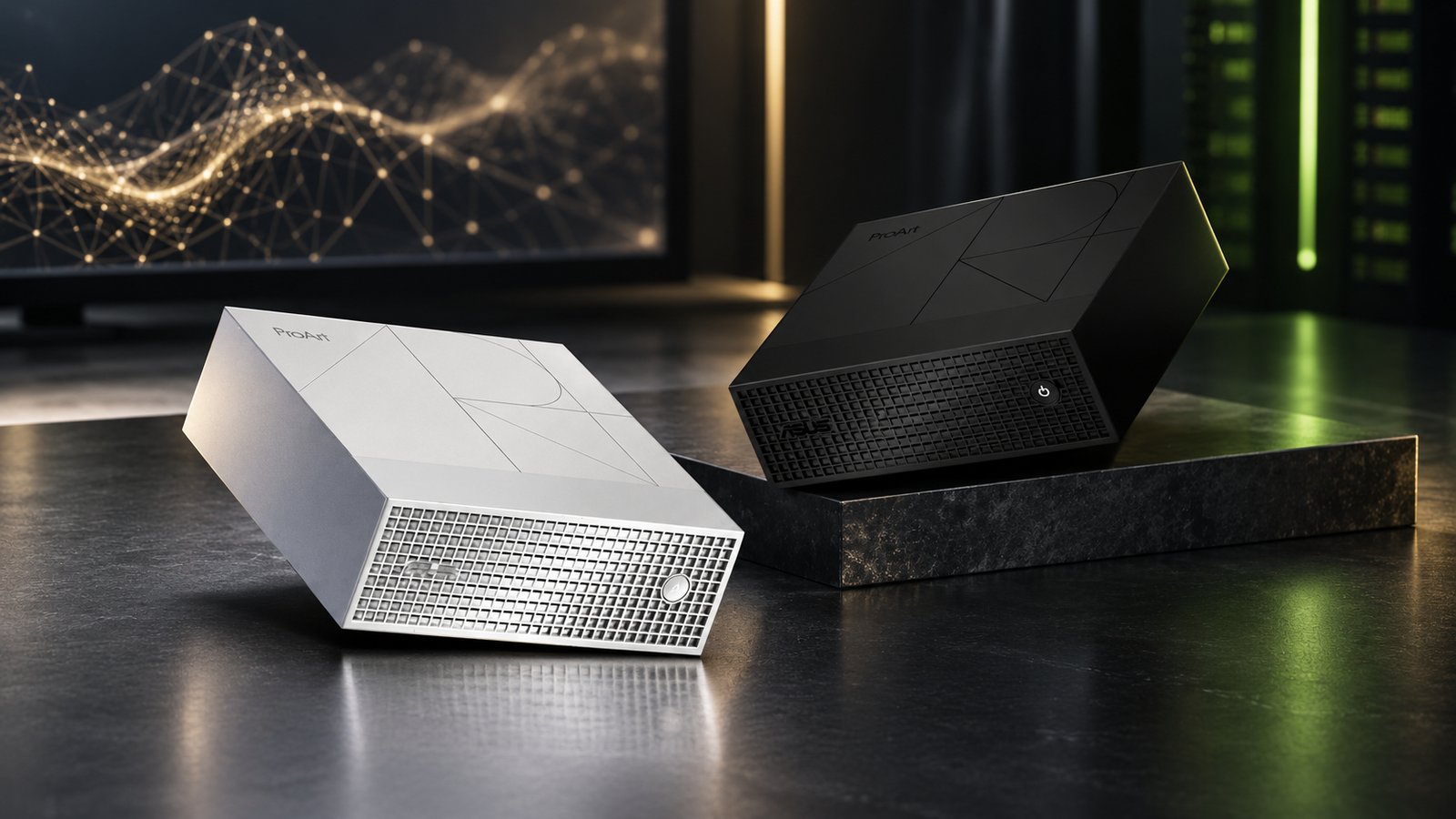
The ASUS ProArt GR1X is a new addition to the ProArt series, designed for local AI computing and professional creative applications. Announced at IFA 2026, this mini PC is based on NVIDIA’s RTX-Spark platform and features the Grace-Blackwell architecture with up to 128 GB of shared LPDDR5X memory.
The GR1X measures just 150 × 150 × 51 millimeters, making it slightly larger than a typical mini PC. It is designed to achieve up to one petaflop of FP4 computing performance and support a sustained power consumption of up to 140 watts.
The technical highlight is NVIDIA’s RTX-Spark superchip, which combines ARM-based Grace CPU cores with a Blackwell GPU. This setup allows the CPU and GPU to access the same memory pool, reducing data transfer via PCI Express compared to conventional PCs. This is particularly beneficial for local AI applications, language models, and image generators that require large memory capacities.
For example, the GR1X can handle 3D scenes up to 90 GB natively, without the need to constantly move data between system and graphics memory. The AI performance of up to one petaflop is specific to FP4 calculations, which reduce memory requirements and increase computational throughput. However, this performance metric is not directly comparable to conventional FP32 computing performance or the gaming performance of a GeForce graphics card.
The GR1X’s cooling system is robust, featuring two fans with 109 blades each, designed to handle the thermal challenges of sustained high performance. This setup ensures that the CPU and GPU can maintain their clock speeds during long calculations, making it suitable for continuous workloads like 3D rendering, video editing, and local inference.
Networking capabilities include a 10-Gigabit Ethernet port and Wi-Fi 7, making it ideal for use as a compact compute node in a local studio or corporate network. The fast network connection is crucial for transferring large models, videos, and 3D data, especially when multiple workstations access central project data or models are loaded from a NAS.
ASUS positions the ProArt GR1X as an “Agent Computer,” designed for continuous operation of AI agents in the background. This local execution keeps sensitive data on the user’s system, eliminating transmission latency and ongoing fees for cloud accelerators. However, it’s important to note that a compact mini PC cannot replace a large data center. Its strength lies in the combination of high memory capacity, NVIDIA software support, and a small footprint.
ASUS has not yet announced a specific retail price or a final release date for the ProArt GR1X. For more details, you can check out the original article on Igor’s Lab.